Here's hoping all of you are enjoying the two-day school reprieve that is the weekend; keep your eyes peeled this week for lots of big PAX announcements and updates!
Sunday, March 13, 2011
First Week Milestone
Here's hoping all of you are enjoying the two-day school reprieve that is the weekend; keep your eyes peeled this week for lots of big PAX announcements and updates!
Saturday, March 12, 2011
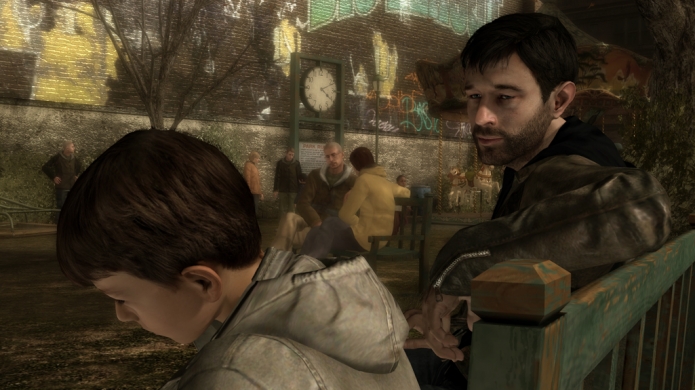
The Emotional Impact of Children in Video Games: Heavy Rain
Video games are usually a teenager/adult-only affair, with everyone fighting in the battles being age-appropriate and with sufficient traits/flaws to make their fates reasonable. Every protagonist is an able-bodied adult male or female. However, occasionally in this day and age, you come across a game featuring children, either as a driving force for the protagonist's motivations or as a representation of an important moral choice. It is around this time that the social and action dynamic of the game often changes to reflect the subject matter.
Heavy Rain: The story of Heavy Rain revolves around the presence of the Origami Killer, a serial killer who abducts young boys and drowns them in rainwater after several days, leaving an orchid in their hands and mud on their faces. Most importantly, however, most of the game revolves around the abduction of Shaun Mars, the son of one of the main characters, Ethan, and is a race against the clock to prevent Shaun's untimely death (caution, spoilers ahead).
Much of the story is centered on Ethan Mars and his attempts to save Shaun from his fate, and are redoubled as a result of his guilt for a car crash that resulted in the death of his first son Jason and Ethan lying in a coma for six months, shortly thereafter resulting in his divorce from his wife (which is only ever alluded to, but never mentioned directly). You find out later on in the game, through messages received by Ethan from the Origami Killer, that he, the father, must prove he has the strength and courage necessary to save his son through a series of trials. If you play the game so that Ethan survives to see the end of the game (your actions have consequences here), you find Shaun in a grate-covered hole in an old factory, and have to break the lock to rescue him.
What's interesting about this final part, and the game in general, is the connection you as the player feel with this computer-generated little boy. Throughout the course of the game, while you are put through trials, you are given the option to walk away from them. While your choice to do so will alter the ending of the game, you will progress through the game regardless, giving no practical reason to go through all the effort of completing the trial, save one: your own connection to the relationship between this father and his son. I found myself genuinely caring about the well-being of Ethan after, through my actions, he suffered electrical burns attempting to navigate a series of live wires to ascertain a clue to the location of his son. I frequently reanalyzed evidence and clues to Shaun's whereabouts to make sure I had the correct address so that I would not put him in danger. When trying to free Shaun from his cage that was slowly filling with rainwater, I found myself frantically tapping buttons to work faster at releasing him, desperately racing against time and then audibly breathing a sigh of relief when I was successful in extracting and then resuscitating him. Below, I have posted this scene from the game:
Heavy Rain: The story of Heavy Rain revolves around the presence of the Origami Killer, a serial killer who abducts young boys and drowns them in rainwater after several days, leaving an orchid in their hands and mud on their faces. Most importantly, however, most of the game revolves around the abduction of Shaun Mars, the son of one of the main characters, Ethan, and is a race against the clock to prevent Shaun's untimely death (caution, spoilers ahead).
Ethan and Shaun Mars
Much of the story is centered on Ethan Mars and his attempts to save Shaun from his fate, and are redoubled as a result of his guilt for a car crash that resulted in the death of his first son Jason and Ethan lying in a coma for six months, shortly thereafter resulting in his divorce from his wife (which is only ever alluded to, but never mentioned directly). You find out later on in the game, through messages received by Ethan from the Origami Killer, that he, the father, must prove he has the strength and courage necessary to save his son through a series of trials. If you play the game so that Ethan survives to see the end of the game (your actions have consequences here), you find Shaun in a grate-covered hole in an old factory, and have to break the lock to rescue him.
What's interesting about this final part, and the game in general, is the connection you as the player feel with this computer-generated little boy. Throughout the course of the game, while you are put through trials, you are given the option to walk away from them. While your choice to do so will alter the ending of the game, you will progress through the game regardless, giving no practical reason to go through all the effort of completing the trial, save one: your own connection to the relationship between this father and his son. I found myself genuinely caring about the well-being of Ethan after, through my actions, he suffered electrical burns attempting to navigate a series of live wires to ascertain a clue to the location of his son. I frequently reanalyzed evidence and clues to Shaun's whereabouts to make sure I had the correct address so that I would not put him in danger. When trying to free Shaun from his cage that was slowly filling with rainwater, I found myself frantically tapping buttons to work faster at releasing him, desperately racing against time and then audibly breathing a sigh of relief when I was successful in extracting and then resuscitating him. Below, I have posted this scene from the game:
Also worth noting as both an extension and a conclusion to my previous thought is the reason for the determination in this type of game to save this child, which is the simple fact that it is a child. Whether it be because its a biological imperative programmed into us to protect children, or simply our empathetic understanding that this is a small creature that loves unconditionally and relies on you for your protection, you feel a kinship to this computer-generated child, and their survival becomes directly linked to the survival you perceive for yourself. Although I know nothing of being a father, I imagine this game emulates the relationship between a father and his son to a degree not seen before in a video game.
Friday, March 11, 2011
Video: Star Wars - The Old Republic at GDC
Anyone who knows me knows how excited I am for this game to be released. It has everything I want a game to have: Star Wars (I'm a big fan) and a massively multiplayer universe. Granted, I don't always love MMOs, and have only played a few, but they, when done right, are fun and addicting as hell (I'm pointing an accusatory finger at you, World of Warcraft). From what I've been seeing thus far in the development of Star Wars: The Old Republic, I do not think I have anything to worry about. I have the utmost trust in Bioware, as I have yet to play a game of theirs that was anything less than stellar, and the third entry in their Mass Effect series is one of my most anticipated titles of 2011.
For those who do not know, the Penny Arcade Expo (PAX), a convention for all things "nerd" in Boston, is happening this weekend. And I'm stuck here in Los Angeles.
Crap.
Anyway, there's going to be lots of trailer premieres and live gameplay demos at the convention this weekend, which I plan on reviewing extensively next week, including new footage of SW:TOR and Brink, an upcoming shooter (and these are just two of the games right off the top of my head... it's a good weekend to be a gamer). I plan on doing a full write-up of my impressions once I have the new footage in hand (or on screen, as the case may be).
Until then, have a great weekend, everyone, and keep checking the blog for updates!
Thursday, March 10, 2011
Impressions: LA Noire's Investigation & Interrogation Trailer
Rockstar Games recently released the latest in a series of trailers for their 1940's crime drama LA Noire, this one focusing on both the investigative and interrogative tactics used by the game's main character, Cole Phelps, a police officer moving up through the ranks in Los Angeles. One of the hallmarks of the title, which have been talked about extensively in interviews and developer videos, is the facial animation technology for this game, which records a motion-capture actor/actress' every facial expression and then transfers both their likeness and their facial nuances into the game at a near-perfect level (it's really something to see - check out the trailer for some examples; I'll include a previous video at the end of this post, as well as the facial animation tech video).
The Good:
Facial Animations: This is a whole new level of motion capture; it almost makes Uncharted look not as incredible as it is. Almost. Every wrinkle, every sneer, every blank expression on someone's face is captured. If you look closely, you'll see that they are using Greg Grunberg (Matt Parkman from Heroes and veteran video game voice actor), John Noble (Walter Bishop), as well as a few others (anyone recognize a Dinner For Schmucks alum?).
Gameplay: It looks very similar in gameplay to both Grand Theft Auto and Red Dead Redemption, which makes sense given that they have the same developer. The similarity does not bother me; both GTA and Red Dead were awesome games, so it bodes well for this title!
Interrogation: From the small snippets they show of it in the trailer, it looks well thought out. Your questions and line of questioning being based on the subtle facial tics displayed by the alleged perpetrator is a very fresh idea and, if it plays anything like it looks in the trailer, should be nerve-wracking (in a good way) in the game. I'd be curious to know if you can fail a case in the game?
The Bad/ The "Why?"
Color Palette: Maybe it's just me, and it's not all the time in the trailer, but I feel like the colors look a bit washed out on occasion, especially when it comes to character's faces and clothing; skin is a pale, blanket color occasionally, and suits look like they've been white-washed. Not a deal-breaker by any means, but definitely something I'd watch for in later trailers.
Wednesday, March 9, 2011
Impressions: Uncharted 3 Footage at GDC
I'll start off this post by making one thing about myself perfectly clear: I love the Uncharted series, and their developer Naughty Dog. For those who have never played either of the two Uncharted titles, I'd describe them as an action/adventure game that applies the Indiana Jones formula to itself: treasure hunting, shootouts, beautiful women, and betrayals (won't link to this one - wouldn't want to spoil it for those of you who haven't played the game!). What results is simply the most fun I've had in a video game in quite some time. The main character, Nathan Drake, is a treasure hunter who, while cheeky, cocky, and arrogant, has a big heart and is fiercely loyal to his friends. Over the course of the first two games, which play much like the plot points of an Indiana Jones or Tomb Raider film, Nathan takes on mercenaries, ex-girlfriends, war criminals, sassy news reporters, and yetis (yes, yetis). Do not take my word for it however; if you have not played either, go out now and buy them.
Yes, right this second. I'll wait.
Okay, good, you're back. Several months ago, Uncharted 3: Drake's Deception was revealed to the public at the Video Game Awards (VGAs), which was followed by a live gameplay demo on Jimmy Fallon shortly thereafter; I've included both of the videos at the end of this post.
The footage featured in this post is a cinematic sequence from the third game, revealing for the first time who the villain will be in Uncharted 3: Katherine Marlowe, the head of a four hundred year-old cabal, one of whose deceased agents is Nathan's ancestor Sir Francis Drake, the subject of the first game.
The Good:
Nemesis: She looks and sounds positively sinister, and reminds me heavily of Helen Mirren. I have a feeling she is going to be a much different nemesis than Lazarevic, the brutal war criminal from the second game; she seems a lot more connected and prone to manipulation.
Graphics: The cutscene, while cool, is even cooler for another reason: all of Uncharted's cutscenes are in-engine. What this means is, all the gameplay looks just as good as the cutscenes (which is a rarity in games). That lighting and those character models? All in-game, friends!
Sully: He's back! While he played a diminished role in the second game, his role will be much more important in this game, and the relationship between himself and Drake will definitely be a focus.
The Bad/ The "Why?":
Marlowe: Her facial animation when seeing the ring seemed... off to me. Anyone else reminded of Gollum in Lord of the Rings?
As promised, here is the debut trailer and the gameplay demonstration:
Tuesday, March 8, 2011
Review: Bulletstorm (Xbox 360)
Developed by Epic Games, in conjunction with People Can Fly, Bulletstorm is a first-person shooter title revolving around a group of ex-special forces space pirates who mutiny against their murderous and corrupt former general and, through a sequence of events, find themselves marooned on a hostile planet, where the only thing that wants to kill them more than the general trapped there with them are the psychotic flora and fauna that call the planet Stygia their home.
As I did not play the multiplayer component to this game extensively (after beating the game, I did not have much interest in coming back to play the multiplayer), I won't be talking about it in this review.
The Good:
Skillshots: Bulletstorm's claim to fame can be found in its skillshot system, an inventive way of killing your opponents that nets you varying amounts of points based on the creativity and difficulty of said kill (and arguably the spiritual successor to Bizarre Creations' game The Club. These skillshot points function as a currency system, allowing the player to buy ammunition and upgrades for their weapons based on their performance. These skillshots, at least for me, encouraged me to play the game in ways I normally wouldn't, such as using the environment to kill enemies, and extended my interest in the game past the simple "point and shoot" aspect of its first-person roots.
Main character: You play as Grayson Hunt, a space pirate/ex special-forces type who maroons his crew on Stygia. Generally a drunken, idiotic chauvanist idiot, his character would normally be one to immediate write off and forget about. Not so in this game. What separates this character from the countless other "space marines" in similar games is how Grayson, and his guilt-tripping squadmate Ishi, bring morality into the shooter genre. Several times over the course of the game, you are told by Ishi to question why it is that your character thinks it's okay to make the general's ship crash into the planet, killing hundreds of people on bored, why your character's revenge against the general for his betrayal is worth all of their lives. As a result, your character does express remorse for his actions and their results, both for his squad and for those he fights against. While the story was not ground-breaking, it takes guts to bring an emotional aspect to a potentially brainless character (although the best example of morality in a first-person shooter belongs to the Bioshock series).
Graphics: This is a very pretty game. Colors are stunning and really "pop", as well as being extremely diverse (no brown, grey and red Gears of War color scheme here). In addition, the dynamic lighting featured in the game, with the way shadows react to each light source, is definitely the cream of the current crop
The Bad:
Story: While the morality is definitely a high point in current shooters, the rest of the story is (mostly) forgettable. There were the typically predictable ups and downs of every shooter, with squadmates being killed and your character finding exits and routes through dumb luck. The ending especially was... well, for lack of a better word, terrible. It ended with the fate(s) of one (or more, I won't spoil) characters up in the air, and ends without closure. The ending suffers from what I call "Sequel Syndrome", where a fresh IP (intellectual property) is set up to have an unfulfilling ending specifically so that a sequel can be made for the title, which is done often with movies as well.
Weapons: Outside of the explosive-chain gun, most of the weapons in this game are ultimately forgettable, and not much fun to use once you've completed the lists of skillshots associated with them. The guns, while fairly common in most shooters (shotgun, sniper rifle, assault rifle, etc, all modified for this game), just felt tacked-on when I played the game, and I did not spend much time using them once I did not have to anymore.
The "Why?":
The Ending: I know I already addressed the ending, but the sequel-set-up of an ending in this game just seems like such a boneheaded move, given the developer. Epic Games, the same studio that made Gears of War, has enough experience making shooters that this could have been easily avoided, and I am disappointed that it wasn't.
My Score: 8/10
While a fun game with some interesting and unique facets, Bulletstorm is ultimately forgettable, failing to truly distinguish itself from all the other shooters on the market. While potentially great, I feel that this is a game destined for the used-game section of your local video game store.
Recommendation: Rent it.
Monday, March 7, 2011
Impressions: Battlefield 3 footage at GDC
The Game Developers Conferenece (GDC) was held last week at the Mascone Center in San Francisco, CA. During the span of the week, Electronic Arts released a gameplay trailer for Battlefield 3, a continuation of the popular Battlefield series being developed by DICE, a Swedish game development company. The release of this trailer had been teased several weeks before, showing several brief glimpses of gameplay, but the trailer released last Wednesday was the first (mostly) uninterrupted display of how the game looked and played that was seen by the general public; there was also a closed-doors demonstration of the game that was filmed and leaked to the Internet, naturally. This same demonstration was detailed in the March 2011 edition of the magazine Game Informer, with attention given both to the demo and to the technology driving it, such as the updated Frostbite engine (which allows for better visuals and audio, higher destructability of the in-game environment, and the quicker development of character animations, allowing for a much more varied approach to how both the player's character and computer characters behave during gameplay and cutscenes) and the company's use of ANT technology, the same animation technology that powers many of Electronic Arts' sports games, FIFA being one example.
The Good:
-Animations: They looked incredible in both the trailer and the leaked video. Characters stacking up against doorways to clear houses, soldiers sprinting down alleyways, and the player dragging a wounded comrade out of harm's way... it all looks great.
-Graphics: It's still early, and the release is not until this fall, but the graphics are really raising the bar, both for the Battlefield series and for games in general. The dynamic lighting is incredible (if you don't believe me, check out that alleyway and the unlit house), and everything is crisp.
-Gameplay: It looks FUN, which seems to be an afterthought these days when it comes to how your game looks (I'm looking at you, Force Unleashed 2). Clearing houses, gunfights in the streets... oh yes, I'm excited. Granted, I have not played this game at all, nor will I be likely to before its release date, but if it plays anything like Bad Company 2, it's going to be another fun entry in the Battlefield series.
-Audio: You. Hear. Everything. If they had a guy sneezing from down the block, I guarantee you would be able to hear it. The sound, while often underutilized in games, makes or breaks a lot of games, and it's
The Bad/The "Why?"
-Nothing: Sure, all we've seen of this game has been in those three trailers, and they're all roughly the same material, but I loved every second of that trailer. The work DICE put into building a new Frostbite engine definitely shows in the game, and it looks like this could be raising the bar for what we can expect to see in shooter games moving forward. As Robert Bowling, creative strategist at Infinity Ward, has gone on record saying that they will not be updating the engine they have been using for Call of Duty for the last several years, DICE and EA definitely seem to be looking to give Activision, owners of Infinity Ward, a run for their money.
Subscribe to:
Posts (Atom)